product range |
|
 |
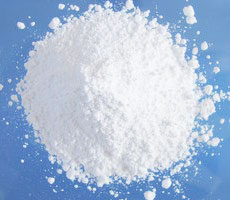
Aluminium Trihydrate
We formulate and export a wide range of Aluminium
Trihydrate. Aluminium Trihydrate are available in different uncoated and
coated grades, with average particle size varying from 2 microns to 10
microns as per application. Aluminium Trihydrate is a common primary
ingredient present in most solid surface material and accounts for as much
as 70% of the total product.
Synonyms
Aluminium Trihydrate are also known as Hydrate Alumina, Alumina Hydrate,
Aluminium Tri Hydroxide, ATH, Aluminium Hydrate and Aluminium Hydroxide.
|
|
| Specification
of Aluminium Trihydrate |
| Al2O3 |
64.7% |
| Fe2O3 |
0.0205% max |
| SiO2 |
0.025% max |
| Na2O (Total) |
0.35% max |
| Al(OH)3 |
99.8% max |
| Sp. gravity |
2.4 g/cc |
| LOD at 1100C |
0.4% max |
| Loss on ignition at 10500C |
34% |
| Residue on 325 Mesh |
NIL |
| Average Particle Size |
Varies as per grades |
|
|
|
Physical Properties:
- Powdery substance
- Odorless
- Non-carcinogenic
- Contains thermal characteristic that provides translucency and
whiteness to
- Solid surface material
- Non-smoking
- Low-toxicity
- Halogen-free
- Flame retardant
Aluminium Trihydrate is used in various industries as:
- A raw material in the production of Aluminium chemicals
- A raw material in the manufacture of glass and glazes
- A raw material in catalyst production
- A flame retardant and smoke suppressant filler in plastics (for
example: Cables, rubber products and carpet backing)
- A raw material for fertilizers, and fiber cement board products
- An extender and bodying agent in paper, solvent- and water-borne
paints, UV curable coatings, inks, and adhesives
- A polishing and cleansing agent
- Mould wash and separating agent
- A filler of cast polymer products such as onyx and solid surfaces
Aluminium
Hydroxide
We offer Percipatated Aluminium Hydroxide,
Al(OH)3, which is a non-abrasive powder with a Mohs' hardness index of 2.5 -
3.5 and a specific gravity of 2.42. Aluminium Hydroxide is considered as one
of the largest volume flame retardant as it can be heated to 200°C and
hydrated alumina can be decomposed into 66% alumina and 34% water. Aluminium
hydroxide is also used as an adsorbent, emulsifier, ion exchanger, mordant,
antacid, and filtering medium. Further, Aluminium Hydroxide can also be used
in manufacturing of paper, ceramics, printing inks, detergents, for
waterproofing fabrics and in dentrifrices and antiperspirants.
|
|
Physical and Chemical Properties:
| Specification of Aluminium Hydroxide : |
| Physical State |
Odorless White Powder |
| Melting Point |
300 C |
| Specific Gravity |
2.42 |
| Solubility In Water |
Insoluble |
| Ph |
Weak Basic |
| Vapor Density |
Autoignition |
| NFPA Ratings |
Health: 1; Flammability: 0; Reactivity: 0 |
| Refractive Index |
Flash Point Not Considered To Be A Fire Hazard |
| Al(Oh)3 |
99.5% Min |
| Al2o3 |
64.0% Min |
| Sio2 |
0.015% Max |
| Fe2o3 |
0.02% Max |
| Moisture |
0.3% Max |
| Loss On Ignition |
34.0 - 35.0% |
| Whiteness |
96% Min |
| Particle Shape |
Platelet, Pseudo-hexagonal |
| Average Particle Size |
1 - 2 Microns |
|
|
|
Synonyms of Aluminium Hydroxide
| Hydrated Alumina |
Aluminium (III) Hydroxide |
| Aluminium Trihydrate |
Trihydroxy Aluminium |
| Trihydrated Alumina |
|
Applications:
- A flame retardant and smoke suppressant filler in plastics like
cables, rubber products and carpet backing
- A filler of cast polymer products such as onyx, solid surfaces and
artificial marvel
- A raw material for fertilizers, and fibre cement board products
- A raw material in catalyst production
- An extender and bodying agent in paper, solvent- and water-borne
paints, UV curable coatings, inks, and adhesives
- A polishing and cleansing agent, mould wash and separating agent
- A raw material in the manufacture of glass, glazes and frits
general description of flame retardant
agent
Flame Retardant are substances that can be chemically inserted into the
polymer molecule or be physically blended in polymers after
polymerization to suppress, reduce, delay or modify the propagation of a
flame through a plastic materials. There are several classes of flame
retardants; Halogenated Hydrocarbons (Chlorine and Bromine containing
Compounds and reactive flame retardants), Inorganic flame retardants (
Boron Compounds, Antimony oxides, Aluminium Hydroxide, molybdenum
Compounds, zinc and magnesium oxides ), Phosphorous containing Compounds
(Organic Phosphate Esters, Phosphates, halogenated phosphorus Compounds
and inorganic phosphorus containing salts).
Class of Flame Retardants
- Inorganic
- Metal hydroxides
- Aluminium hydroxide
- Magnesium hydroxide
- Orthers
- Antimony Compounds
- Antimony trioxide
- antimony pentoxide
- Sodium antimonate
- Others
- Boron Compounds
- Boric acid
- Borax
- Zinc borate
- Others
- Other metal Compounds
- Molybdenum Compounds
- Molybdenum Trioxide
- Zinc Molybdate
- Ammonium Octa Molybdate
- Titanium Compounds
- Zirconium Compounds
- Zinc Compounds
- Zinc Stannate
- Zinc Hydroxystannate
- Others
- Others
- Phosphorus Compounds
- Red phosphorus
- Ammonium polyphosphate
- Others
- Other inorganic flame retardants
- Ammonium Sulfamate
- Ammonium Bromide
- Others
- Organophosphoros
- Non-halogenated Compounds
- Phosphate Esters
- Ttrialkyl Phosphates
- Triaryl Phosphates
- Aryl-alkyl Phosphates
- Others
- polyols
- phosphonium derivatives
- phosphonates
- Others
- Halogenated Phosphates
- Tris(1-chloro- 2-propyl) phosphate
- Tris(2-chloroethyl) phosphate
- Tris(2,3-dibromopropyl)phosphate
- Others
- Nitrogen-based
- Polyurethanes
- Polyamides
- Melamine and its salts
- Guanidine Compounds
- Others
|
 |
product range
|
 |